Key takeaways
- Our Aleppo soap is made by the traditional hot process and cured 10–18 months in ventilated warehouses before shipping.
- A golden-brown or khaki exterior and a green interior are typical of a cured bar. Colour is not a measure of quality, safety or authenticity.
- Curing time is not shelf life. For our soap, shelf life is confirmed per batch on request.
- Store cartons dry, ventilated and out of direct sunlight, and keep the batch number of each delivery.
Buyers receiving Aleppo soap for the first time tend to ask the same four questions. Why is it brown outside and green inside? Why does it take so long to make? What should it smell like? How should it be stored? This guide answers them for wholesale buyers, shop owners and warehouse teams.
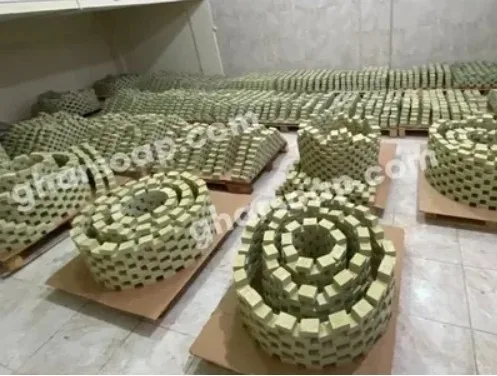
How Aleppo Soap Is Cured
Our Aleppo soap is made by the traditional hot process. Olive oil is saponified in large cauldrons, laurel berry oil is added at the grade percentage, and the soap is poured onto a flat surface, levelled and left to set. The slab is cut into bars by hand, each bar is stamped, and the bars are stacked in ventilated towers to dry.
We cure our bars for 10–18 months before shipping. During curing the bars lose moisture and harden. A curing period is a production step defined by the manufacturer, so ask any supplier to state it for the lot offered. The Aleppo soap guide covers the history of the method.
Why Aleppo Soap Is Green Inside and Brown Outside
The green comes from the oils. Laurel berry oil is green to green-brownish, as described on our Technical Data Sheet, and the inside of the bar keeps a green colour. During curing the surface is exposed to air and darkens to golden-brown or khaki, while the inside stays green. The contrast is visible when a bar is cut or broken.
The shade varies. A 40% laurel bar tends to show a deeper green than a 5% bar, and the oil lot and the length of curing also play a part. Two bars of the same grade can therefore look slightly different. See Aleppo soap laurel oil percentages for how the grades differ.
Colour is not a quality or safety indicator, and it is not proof of authenticity. Use it to compare a delivery with your approved sample, not to judge the soap. Our Aleppo soap verification checklist lists the documents that do the verifying.
What Aleppo Soap Should Smell Like
Aleppo soap has a characteristic herbal laurel aroma that comes from the laurel berry oil; our TDS describes the oil’s odour as herbaceous and spicy. Traditional bars contain no added perfume. The aroma is stronger in the 20% and 40% grades and lighter in the 5% and 10% grades.
Like colour, smell is not a quality or safety test, and its intensity can change over time in storage. If a delivery smells clearly different from the approved sample — for example, perfumed — ask the supplier for the INCI declaration of that lot.
Curing Time Is Not Shelf Life
Curing time and shelf life answer different questions. Curing time is how long the bars were dried before shipping. Shelf life is a statement about how long the finished product is expected to stay within specification under stated storage conditions. Our bars are cured 10–18 months before shipping, and shelf life is confirmed per batch on request.
Two assumptions are worth avoiding. A longer cure is a production choice, not by itself a better bar. And soap does not automatically improve with age in a warehouse. Neither assumption is a specification. Agree the curing period, the shelf-life statement and the storage conditions in writing, and record the batch number of every delivery.
Storing Aleppo Soap in a Warehouse or Shop
- Dry: keep cartons dry and off the floor; damp conditions can mark wrappers and cartons.
- Ventilated and shaded: store in a ventilated area away from direct sunlight and heat sources.
- Packed: keep bars in their packaging until sale. Our packaging options are paper wrap, shrink wrap, kraft boxes and custom branded packaging.
- Rotated: sell first in, first out, and keep the batch number of each carton.
- Retained sample: keep a few bars from each lot for later comparison.
- Temperature changes: after cold transport, let cartons reach room temperature before opening to avoid condensation on the bars.
At goods-in, a short routine saves questions later: count the cartons against the packing list, match the batch numbers on the cartons to the documents, open a carton from each batch to check wrapping and bar condition, and compare a few bars with the retained sample. Record where each batch is stored, so that stock can be rotated and traced.
If you also stock laurel berry oil as a raw material, it has its own storage terms. Our TDS gives a shelf life of 24 months unopened, in the original sealed container. The oil is liquid at ambient temperature and may thicken or partially solidify when stored cool. Full storage details are on the laurel berry oil specification page.
Order Cured Aleppo Soap
Gharsoap manufactures Aleppo soap in Hatay, Türkiye, cured 10–18 months before shipping, in 5%, 10%, 20% and 40% laurel grades. Ask for the curing and shelf-life statement for the lot you are considering.