Key takeaways
- Verification is a document check, not a sensory test. Colour, smell, stamp and COA are each useful, but none is proof on its own.
- Confirm who manufactures the soap and where. The tradition originated in Aleppo, Syria; our soap is manufactured in Hatay, Türkiye.
- Match the INCI declaration, the laurel percentage and the batch documents to the lot you receive.
- Approve on samples from the production lot, then check each delivery against the same file.
“Authentic Aleppo soap” is one of the most common phrases buyers search for, and one of the hardest to check from a product photo. For a wholesale buyer the useful question is narrower: does the soap in this shipment match what the supplier has documented? This checklist sets out how to answer it, step by step.
Step 1: Confirm Who Makes the Soap and Where
Start with the supplier, not the bar. Ask whether the company is the manufacturer or a distributor, and where the soap is produced. A manufacturer should be able to give you its legal company name, its production address and the registration details that appear on its documents.
Be precise about origin. The Aleppo soap tradition originated in Aleppo, Syria; our soap is manufactured in Hatay, Türkiye, by Yedi Dünya Ltd. Şti., and our documents say so. Whatever the supplier, the country of manufacture on the label, on the certificate of origin and in the sales description should be the same.
Step 2: Check the Ingredients and the INCI Declaration
Traditional Aleppo soap has a short ingredient list: olive oil, laurel berry oil, water and sodium hydroxide. The sodium hydroxide is consumed during saponification. Our INCI declaration reads Sodium Olivate, Sodium Laurate, Aqua, Glycerin.
Ask for the INCI declaration in writing and compare it with the label. Added fragrance, colourants or other oils should appear on the declaration if they are used. If the declaration lists ingredients beyond the traditional ones, the bar is a different formulation, whatever name it is sold under. A declaration that does not match the label is a reason to ask questions before ordering.
Step 3: Confirm the Laurel Percentage and the Process
The laurel percentage is the share of laurel berry oil in the oil blend. Ask for it in writing, and ask what it is calculated against. We manufacture 5%, 10%, 20% and 40% grades; our guide to Aleppo soap laurel oil percentages explains what the figures mean.
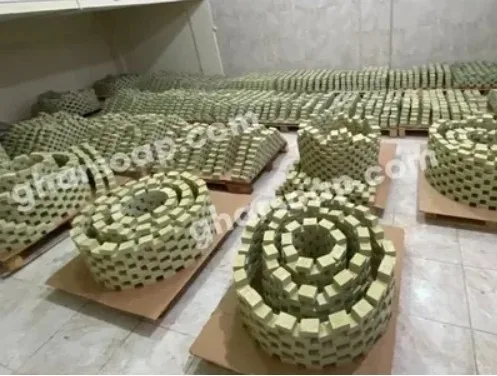
Then ask how the soap is made and how long it is cured. Our bars are made by the traditional hot process, hand-cut, stamped and cured 10–18 months in ventilated warehouses before shipping. Any supplier should state its own process and curing period, for the lot offered rather than in general terms.
Step 4: What the Bar Itself Can — and Cannot — Tell You
Physical checks are useful for comparing samples and deliveries, but none of them proves authenticity on its own:
| Check | What you may see | What it cannot prove alone |
|---|---|---|
| Colour | Golden-brown or khaki outside, green inside when cut | Composition, laurel percentage or origin |
| Smell | Characteristic herbal laurel aroma, no added perfume | Laurel percentage or origin |
| Stamp | A maker’s mark pressed into each bar | Who made the bar or what it contains |
| Hardness | A hard, dry bar | The curing period or the composition |
| COA | Measured values for one batch | That the goods come from that batch, unless the batch numbers match |
Use these checks to compare each delivery with the approved sample, not as a substitute for the documents in Steps 1–3. Our guide to Aleppo soap curing, color and storage explains why colour and aroma vary between bars.
Step 5: Documents, Samples and Delivery Checks
- Samples: request samples from the production lot and keep a retained sample.
- Batch documents: our shipments include a Certificate of Analysis (COA), Safety Data Sheet (SDS), INCI declaration, allergen statement and certificate of origin, with an EUR.1 movement certificate for EU import.
- Batch numbers: check the batch numbers on cartons against the documents.
- Packaging and labelling: bar weight (we make 100 g, 150 g and 200 g bars, with custom sizes available), wrap and carton marks.
- Written specification: agree grade, bar size, packaging, labelling and documents in writing before production.
- Delivery check: compare a few bars from each delivery with the retained sample.
If you will sell under your own brand, the same file becomes your product specification; see white label and private label Aleppo soap.
Red Flags Worth a Follow-Up Question
- The supplier cannot say who manufactures the soap or where.
- The origin on the label, the documents and the sales description do not match.
- A laurel percentage is quoted without saying what it is calculated against, or differs between the quote and the label.
- The INCI declaration is missing, or differs from the label.
- Authenticity is argued only from colour, smell, a stamp or a generic certificate.
- No batch number links the documents to the goods.
- The product is sold with claims that go beyond a cleansing soap; as the brand owner, those claims become your regulatory responsibility.
For the history and ingredients of the soap, read our Aleppo soap guide.
Verify Before You Order
Gharsoap manufactures Aleppo soap in Hatay, Türkiye. Ask for samples from the production lot and the documents you need for supplier approval: COA, SDS, INCI declaration, allergen statement and certificate of origin.